Showing posts with label alkenes. Show all posts

Monday, May 30, 2016

3.8 Describe the addition reaction of alkenes with bromine, including the decolourising of bromine water as a test for alkenes


When an alkene reacts with bromine, it turns one of its double (unsaturated) bonds into a single bond so it can bond with the bromine atoms. For example, ethane (shown below as ethylene) will bond with bromine to form 1,2 dibromoethane. (Br is on molecules 1 and 2, there are 2 of them, and the rest is ethane. That's the naming process aha)

Because of this, Br water will decolorize if you mix an alkane with it. 

It will not decolorize immediately with alkenes because they are saturated.
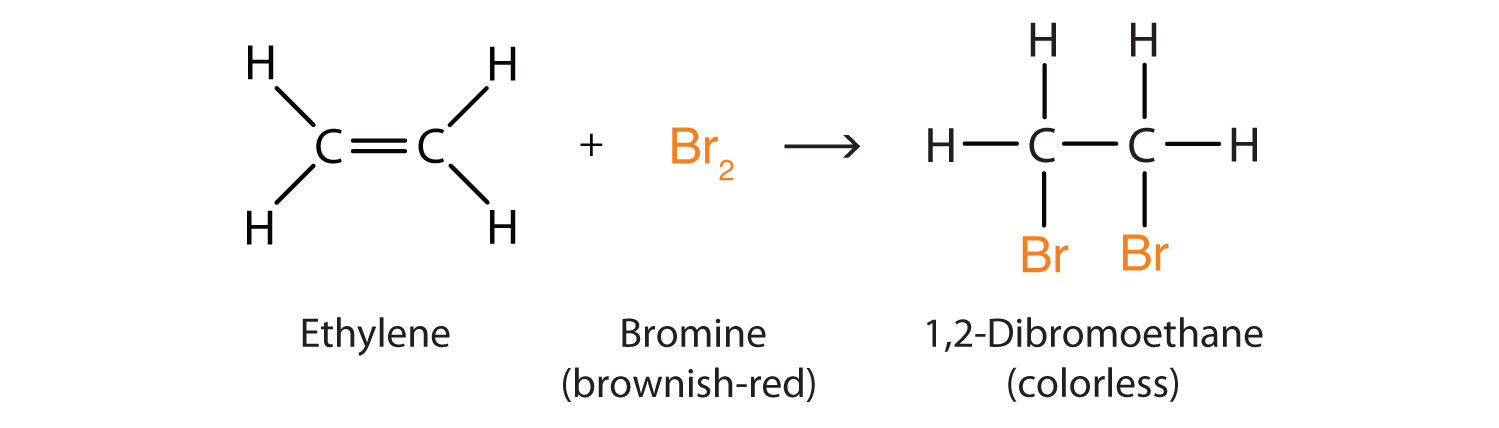


This is a good way to test for alkenes, since there is always a colour change (bromine water turns from brown to colourless) whenever alkenes are put in it.

Also, to bond to two bromines, the alkene must make its double bond a single bond, hence the name addition reaction


Saturday, May 28, 2016

5.14 describe how long-chain alkanes are converted to alkenes and shorter-chain alkanes by catalytic cracking, using silica or alumina as the catalyst and a temperature in the range of 600–700ºC

Passing long-chain hydrocarbons over a hot catalyst (in this case silica or alumina at roughly 600-700ºC) will cause them to break down into smaller chains of hydrocarbons

Some of the atoms are lost from the molecules, making them unsaturated and able to form a double bond. This is how you can get alkenes from cracking, not just short-chain hydrocarbons

3.7 Draw displayed formulae for alkenes with up to four carbon atoms in a molecule, and name the straight-chain isomers

This is where it gets difficult. Because all alkenes have a double carbon to carbon bond, when drawing the displayed formula for an alkene you must always remember:
- Carbon only has four bonds
- Therefore, if two of those are to another carbon
- It will only be bonded to two other hydrogens

3.6 Recall that alkenes have the general formula CnH2n

Basically, all compounds in the homologous group alkenes have the general formula CnH2n, which means that for every carbon atom there are two hydrogen ones