Hello everyone!
I've been away for a long time and I am glad to say I've graduated! I will be pursuing engineering soon. In the meantime, I hope this blog has helped you. Feel free to post corrections and comments. As a student, I know finances will be difficult, so I ask only a minute of your time to check out my Redbubble shop. It is a website that supports independent artists like me. With every purchase you make, I get a small commission. Art is a small passion of mine and it would mean the world to me if you could share this with friends and family so that I might earn a little from this hard work.
On this website: https://www.redbubble.com/people/Carolemonn/shop?asc=u you can find original watercolor works and more which can be printed on a variety of products, from shirts to mugs. Enjoy!
Thank you for your support and all the best with revision!
~ Carolina
Thursday, May 30, 2019

Tuesday, May 31, 2016
5.21 Understand that condensation polymerisation produces a small molecule, such as water, as well as the polymer.
When the two monomers come together, one or more atoms is/are lost. These join together to make a small molecule (i.e. H₂O, CH₃OH (methanol) or HCl). The monomers then join together to make the polymer.
5.20 Understand that some polymers, such as nylon, form by a different process called condensation polymerisation
Condensation polymerisation is a situation in which a polymer is formed, along with a small molecule such as H₂O, HCl or CH₃OH (methanol).
Nylon is an example:

Nylon is an example:
.jpg)
5.19 Explain that addition polymers are hard to dispose of as their inertness means that they do not easily biodegrade
Addition polymers are unreactive because they are saturated, which means they don't biodegrade easily. Solutions used today include:
- burning (not good, produces cancerous / harmful gases)
- landfills (takes up a lot of useful land and harmful chemicals leak into the soil)
- recycling (good for the environment but uses up energy and isn't always cheapest)
5.18 Describe some uses for polymers, including poly(ethene), poly(propene) and poly(chloroethene)
Poly(ethene)
- plastic bags
- light carrier bags
- plastic bottles
poly(propene)
- crates
- ropes
- thermal undergarments
poly(chloroethene)
- water pipes
- wire insulation
5.17 Deduce the structure of a monomer from the repeat unit of an addition polymer
In the simplest terms possible: take away the two 'floating' / empty bonds at the sides and make a carbon carbon double bond between 2 carbons instead.
5.16 Draw the repeat unit of addition polymers, including poly(ethene), poly(propene) and poly(chloroethene)
Repeat units must be drawn:


- within large brackets
- with two bonds sticking out of the brackets
- an n at the end, representing the number of times it is repeated (i.e. n could be anything, you don't write the number, write n)
Poly(ethene) and poly(chloroethene):
Poly(propene)
5.15 Understand that an addition polymer is formed by joining up many small molecules called monomers
Exactly what the point says: addition polymers are made by joining up many small ones called monomers: "mono" meaning one and "poly" meaning many
Monday, May 30, 2016
3.8 Describe the addition reaction of alkenes with bromine, including the decolourising of bromine water as a test for alkenes
When an alkene reacts with bromine, it turns one of its double (unsaturated) bonds into a single bond so it can bond with the bromine atoms. For example, ethane (shown below as ethylene) will bond with bromine to form 1,2 dibromoethane. (Br is on molecules 1 and 2, there are 2 of them, and the rest is ethane. That's the naming process aha)
Because of this, Br water will decolorize if you mix an alkane with it.
It will not decolorize immediately with alkenes because they are saturated.
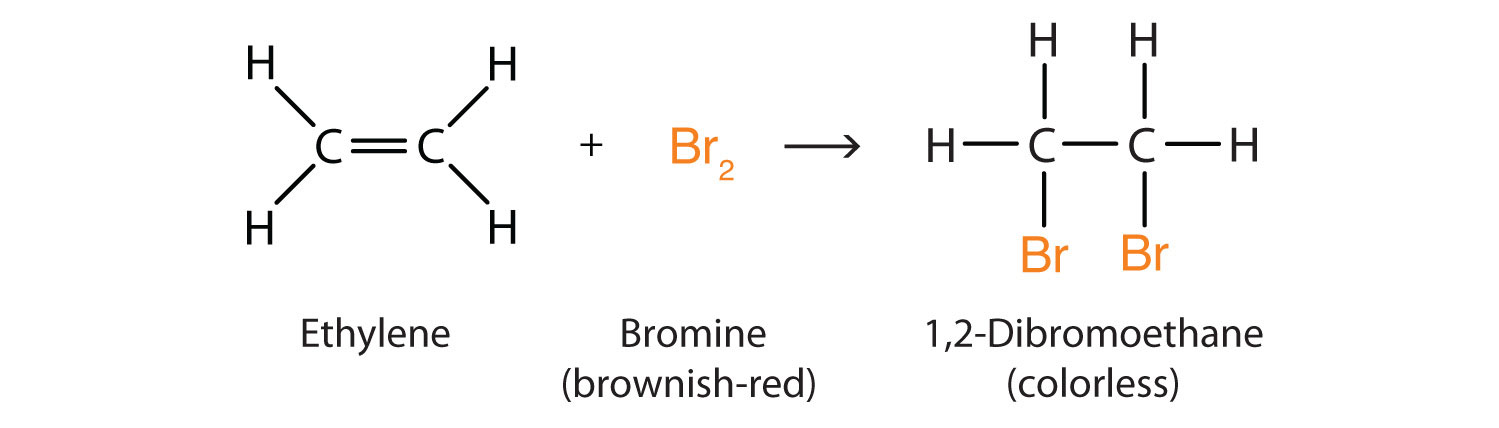
Also, to bond to two bromines, the alkene must make its double bond a single bond, hence the name addition reaction
Sunday, May 29, 2016
1.55 Write ionic half-equations representing the reactions at the electrodes during electrolysis
At positive (anode) electrode, electrons are lost.
eg 2Br- > Br2 + 2e-
At negative (cathode) electrode, electrons are gained.
eg 2H+ + 2e- > H2
*Make sure charges are the same on both sides!!
eg 2Br- > Br2 + 2e-
At negative (cathode) electrode, electrons are gained.
eg 2H+ + 2e- > H2
*Make sure charges are the same on both sides!!
1.54 Describe experiments to investigate electrolysis, using inert electrodes, of aqueous solutions such as sodium chloride, copper(II) sulfate and dilute sulfuric acid and predict the products
- Place inert electrodes in aqueous ionic solution
- At positive electrode (anode), - ion will form an atom (non metal)
- At negative electrode (cathode), + ion will form an atom (metal)
eg
- Sodium chloride: sodium at cathode, chlorine at anode
- Copper(II) sulphate: copper at cathode, oxygen at anode, sulphur stays in solution
- Sulphuric acid: hydrogen at cathode, oxygen at anode, sulphur stays in solution
To help remember:
CINDY IS NOT AN INDECENT POTATO:
Cathode
Is
Negative
Anode
Is
Positive
NAP MAN:
Non-metal
At
Positive
Metal
At
Negative
CCOASS (for copper(II) sulphate)
(Cathy Chopped Apples And Stabbed Sue)
Copper
Cathode
Oxygen
Anode
Sulphur
Solution
HCOASS (for dilute sulphuric acid)
(Henry Cut Onions And Started Sulking)
Hydrogen
Cathode
Oxygen
Anode
Sulphur
Solution
1.53 Describe experiments to investigate electrolysis, using inert electrodes, of molten salts such as lead(II) bromide and predict the products
%20bromide%20image%201.JPG) |
| Figure 1 |
- Set up the apparatus in figure 1
- The lead (metal) will be attracted to the negative cathode where it will gain electrons
- The bromine (non metal) will be attracted to the positive anode where it will lose electrons
- Lead and bromine formed
- Yay
Inert electrodes don't react with other substances - only play a role in electron transfer and you need to be able to draw that apparatus. Good luck, padawan.

1.52 Understand that electrolysis involves the formation of new substances when ionic compounds conduct electricity
Ionic compounds conduct electricity when molten or in solution. During electrolysis, positively charged ions move to one side (cathode, which is the negatively charged electrode) and form metals. The negatively charged ions move to the other side (anode, the positively charged electrode) to form non metals. This is because opposite charges attract. These ions become atoms / new products because they undergo a reaction where either a gain or loss of electrons occurs.
TO REMEMBER:
Cathode
Is
Negative
Anode
Is
Positive
Cindy Is Not An Indecent Potato
TO REMEMBER:
Cathode
Is
Negative
Anode
Is
Positive
Cindy Is Not An Indecent Potato
1.51 Describe experiments to distinguish between electrolytes and non-electrolytes
- Set up a circuit with an LED light, a battery/power pack, wire and a solution
- Create a gap between the two ends of the wire. Place them in the solution.
- Switch the power pack on (if required)
- If LED lights up, a current is flowing through the molten substance / solution. This means it is an electrolyte.
- If it doesn't light up, there's no current, therefore it is not an electrolyte.
Or you could just...

1.50 Understand why ionic compounds conduct electricity only when molten or in solution
When in solution, ions separate (to form + and - ions, accordingly) and they become free to move, so they can carry electricity and so the compound can now conduct when it is molten / in solution.
1.49 Understand why covalent compounds do not conduct electricity
In covalent substances, the electrons are not free to move, so current can't move through the substance; there's no electrons to carry it - no transfer of electricity.
1.48 Understand that an electric current is a flow of electrons or ions
Surprise! An electric current is a flow of electrons or ions. Well done, me.
Saturday, May 28, 2016
5.14 describe how long-chain alkanes are converted to alkenes and shorter-chain alkanes by catalytic cracking, using silica or alumina as the catalyst and a temperature in the range of 600–700ºC
Passing long-chain hydrocarbons over a hot catalyst (in this case silica or alumina at roughly 600-700ºC) will cause them to break down into smaller chains of hydrocarbons
Some of the atoms are lost from the molecules, making them unsaturated and able to form a double bond. This is how you can get alkenes from cracking, not just short-chain hydrocarbons
Some of the atoms are lost from the molecules, making them unsaturated and able to form a double bond. This is how you can get alkenes from cracking, not just short-chain hydrocarbons
5.13 Understand that fractional distillation of crude oil produces more long-chain hydrocarbons than can be used directly and fewer short-chain hydrocarbons than required and explain why this makes cracking necessary
The main problem is that long-chain hydrocarbons are more viscous and less flammable, whereas the short-chain hydrocarbons flow and burn well, which makes them more useful.
However, as the title said, more long-chain hydrocarbons are produced then short-chain ones.
TADA! We have cracking, which breaks up the longer, less useful hydrocarbons into shorter, more useful hydrocarbon
However, as the title said, more long-chain hydrocarbons are produced then short-chain ones.
TADA! We have cracking, which breaks up the longer, less useful hydrocarbons into shorter, more useful hydrocarbon
5.12 Understand that nitrogen oxides and sulfur dioxide are pollutant gases which contribute to acid rain, and describe the problems caused by acid rain
NO (nitrogen oxide) is produced in car engines.
When nitrogen oxide and sulfur dioxide are in the atmosphere they react with rainwater to create H+ ions, making it more acidic. This means that when rain falls it can alter the PH in soil or rivers which will severely affect the ecosystem. It can also corrode limestone, damaging rocks, buildings (a big problem if the buildings are historical ones)
When nitrogen oxide and sulfur dioxide are in the atmosphere they react with rainwater to create H+ ions, making it more acidic. This means that when rain falls it can alter the PH in soil or rivers which will severely affect the ecosystem. It can also corrode limestone, damaging rocks, buildings (a big problem if the buildings are historical ones)
Subscribe to:
Posts (Atom)