Showing posts with label Bonding. Show all posts

Sunday, November 15, 2015

1.40 Explain, using dot and cross diagrams, the formation of covalent compounds by electron sharing for the following substances...


Here are dot and cross diagrams to represent the covalent bonds between the following substances:

  • Hydrogen
  • Chlorine
  • Hydrogen chloride
  • Water
  • Methane
  • Ammonia
  • Oxygen
  • Nitrogen
  • Carbon dioxide
  • Ethane
  • Ethene

This website covers hydrogen, chlorine, hydrogen chloride, water, methane ammonia, and oxygen.

The rest can be found here (quizlet) or click on the "Formulas 1.40" page on the right side ^_^


Friday, November 13, 2015

1.47 Explain the electrical conductivity and malleability of a metal in terms of its structure and bonding.


  • Metals have a high melting and boiling point because there are so many strong metallic bonds, which require a lot of energy to break, especially in giant structures.
  • They are good conductors of electricity because their delocalized electrons carry electricity, which means that an electric current passes through very easily.
  • Metals are made of layers of atoms which can slide on top of each other, so when force is applied, they slide, making them malleable and change shape relatively easily.

1.46 Understand that a metal can be described as a giant structure of positive ions surrounded by a sea of delocalised electrons

A metal has a giant structure, meaning that it's made up of hundreds and thousands of positive ions. These are surrounded by a 'sea' of delocalised electrons. This means that they aren't 'bound' to any particular atom and are free to roam within the structure.

Source: BBC Bitesize
Figure 1

1.45 Explain how the uses of diamond and graphite depend on their structures, limited to graphite as a lubricant and diamond in cutting.


  • Diamond is often used at the tips of drill bits or certain blades because it is very hard. This is because it has many strong covalent bonds that are not at all easy to break.
  • Graphite is used as a lubricant because its layers are held together by weak binding forces, which means they slide over each other. Even when you have graphite in your pencil, when you write, the layers slide onto the paper :)

1.44 Draw diagrams representing the positions of the atoms in diamond and graphite

Atoms in diamond have 4 covalent bonds each. Atoms in graphite are bonded to 3 others and have layers held together by weak binding forces.

Figure 1: Structure of Graphite and Diamond
Figure 2: What they expect your diagram of diamond to look like :)

Tuesday, November 10, 2015

1.43 Explain the high melting and boiling points of substances with giant covalent structures in terms of the breaking of many strong covalent bonds

A giant covalent structure is one that has many many many atoms with covalent bonds between each other. These bonds are very strong. Because of this, a lot of energy is needed to break them to cause a change of state. Therefore, these substances have high melting and boiling points.

1.42 Explain why substances with simple molecular structures have low melting and boiling points in terms of the relatively weak forces between the molecules

Basically:

  • They have less atoms
  • Forces of attraction are weaker
  • Less energy is needed to break the bonds
  • The result is a lower boiling/melting point
(see also 1.41)

1.41 Understand that substances with simple molecular structures are gases or liquids, or solids with low melting points

A simple molecule, with only a few atoms, will not have a very high melting/boiling point. This is because it has relatively weak bonds, therefore they will not be that hard to break, and little energy is required to do so :)

1.39 Understand covalent bonding as a strong attraction between the bonding pair of electrons and the nuclei of the atoms involved in the bond

Electrons shared in the covalent bond are attracted to the nucleus of each atom, because the nucleus is positive and the electrons are negative. These bonds are held by the strong force of a attraction.

1.38 Describe the formation of a covalent bond by the sharing of a pair of electrons between two atoms

Covalent bonds are formed when atoms share electrons. This, also, is an attempt to gain a full outer shell and therefore become more stable.

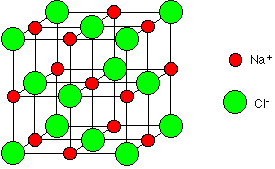
1.37 Draw a diagram to represent the positions of the ions in a crystal of sodium chloride.

In a lattice structure, the negative touch the positive (and vice versa)
Figure 1: Not my own image, sozzies.

1.36 Describe an ionic crystal as a giant three-dimensional lattice structure held together by the attraction between oppositely charged ions

An ionic crystal is a giant 3D lattice structure held together by the attraction between oppositely charged ions through electrostatic attraction :)


1.35 Understand the relationship between ionic charge and the melting point and boiling point of an ionic compound

The bigger the difference in charge, the stronger the electrostatic attraction. 
Figure 1: Drawn by me

Figure 2: Drawn by me
This is because the stronger the electrostatic attraction, the harder it is to break, which means more energy is required, therefore it has a higher boiling point :)

1.34 Understand that ionic compounds have high melting and boiling points because of strong electrostatic forces between oppositely charged ions

Ionic compounds have high melting/boiling points because the electrostatic forces between oppositely charged particles are so strong that a lot of energy is required to break them.

1.33 Understand ionic bonding as a strong electrostatic attraction between oppositely charged ions

Ionic bonding happens with oppositely charged ions because they are attracted to each other because of their opposite charges (electrostatic attraction) which bonds them to form an ionic compound.

Basically, ionic bonding is a strong electrostatic attraction between oppositely charged ions.

Note that ionic bonding happens between metals and non metals

1.32 Explain, using dot and cross diagrams, the formation of ionic compounds by electron transfer, limited to combinations of elements from Groups 1, 2, 3 and 5, 6, 7

Atoms react, bonding with each other, in an attempt to fill their outer shell. Full outer shells mean that the atom is stable. Ionic bonding involves oppositely charged atoms being formed due to a gain/loss of electrons.

I.e.
Figure 1: Drawn by me, all shells showing

Figure 2: Drawn by me, only outer shells showing

Friday, November 6, 2015

1.30 recall the charges of common ions in this specification

Positive

  • K +
  • Na +
  • Li +
  • H +
Doubly Positive
  • Mg 2+
  • Ca 2+
Triply Positive
  • Al 3+
Negative
  • Cl-
  • Br-
  • I-
  • F-
  • OH-

Doubly Negative
  • SO4 2-
  • CO3 2-


Triply Negative

  • NO 3-

1.29 Understand oxidation as the loss of electrons and reduction as the gain of electrons


Oxidisation is the loss of electrons and reduction is the gain of electrons in a chemical reaction.

1.28 Describe the formation of ions by the gain or loss of electrons .


Ions are like positive or negatively charged versions of atoms. If an atom loses an electron in a reaction, it becomes positive in relation to the amount of electrons it has lost. If an atom gains an electron, it becomes negative in the same way. I.e. if Potassium reacts with something, it will lose one electron (it only has one in its outer shell) and will become +1. Atoms react in an attempt to fill their outer shells so they can be more stable.