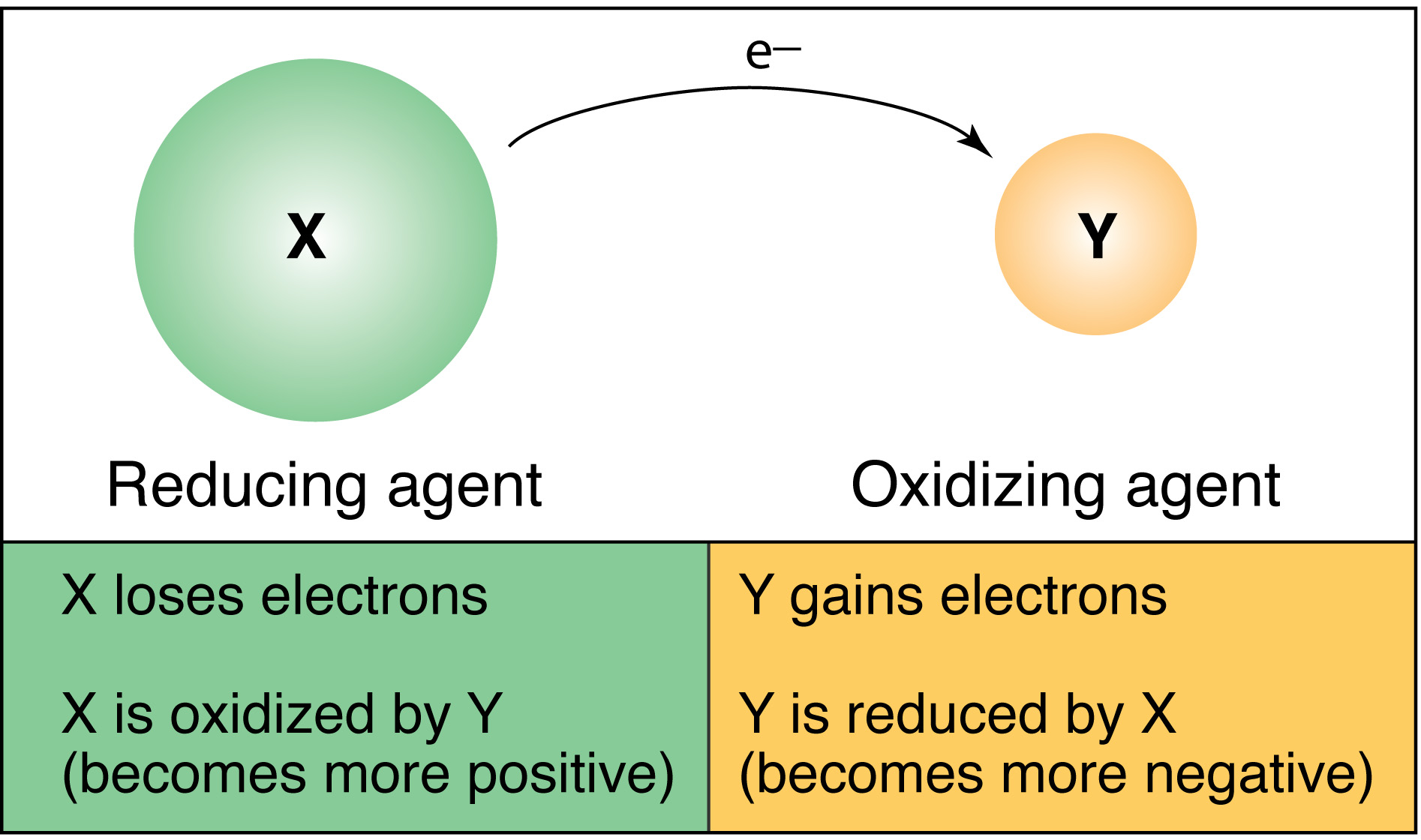
When a more reactive halogen displaces a less reactive halogen, it's called a redox reaction. This is because an element has gained something and the other has lost something:
OIL RIG:
Oxidisation
Is
Loss (of electrons)
Reduction
Is
Gain (of electrons)
Showing posts with label Reactions. Show all posts
Friday, November 13, 2015
2.14 Describe experiments to demonstrate that a more reactive halogen will displace a less reactive halogen from a solution of one of its salts
A more reactive halogen will displace a less reactive one in a solution of its salt but only if the salt is dissolved in water or a gas.
Eg. if chlorine (Cl) is added to a solution of sodium bromide, it will form a solution of sodium chloride instead, and bromine will become a 'waste' product.
The balanced equation would be:
Cl2 + 2NaBr → 2NaCl + Br2
Friday, November 6, 2015
1.28 Describe the formation of ions by the gain or loss of electrons .
Ions are like positive or negatively charged versions of atoms. If an atom loses an electron in a reaction, it becomes positive in relation to the amount of electrons it has lost. If an atom gains an electron, it becomes negative in the same way. I.e. if Potassium reacts with something, it will lose one electron (it only has one in its outer shell) and will become +1. Atoms react in an attempt to fill their outer shells so they can be more stable.
1.22 Use the state symbols (s), (l), (g) and (aq) in chemical equations to represent solids, liquids, gases and aqueous solutions respectively
Whoops I covered this too early in 1.21… anyway.
(s) = solid
(l) = liquid
(g) = gas
(aq) = aqueous, meaning dissolved in water
These are written next to the element (right) in subscript. I.e. HCl(aq)
1.21 Write word equations and balanced chemical equations to represent the reactions studied in this specification
The equation must have at least one reactant (usually 2 though), and a product (again, usually two), and there must be the same number of atoms on both sides - that’s where the balancing comes in.
i.e. H2O(l) → H2O(g) This equation is balanced (it shows water going from one state to another)
Na(s) + H2SO4(aq) → NaSO4(aq) + 2H(g) This equation had to be balanced. You do this by putting a big number in front of the element. DO NOT add a small number because you will lose marks for that.
You don't need to balance word equations but for the reaction above, it would be:
Sodium + Sulphuric acid → Sodium Sulphate + Hydrogen gas
Subscribe to:
Posts (Atom)