Tuesday, May 31, 2016
5.15 Understand that an addition polymer is formed by joining up many small molecules called monomers
Exactly what the point says: addition polymers are made by joining up many small ones called monomers: "mono" meaning one and "poly" meaning many

Monday, May 30, 2016
3.8 Describe the addition reaction of alkenes with bromine, including the decolourising of bromine water as a test for alkenes
When an alkene reacts with bromine, it turns one of its double (unsaturated) bonds into a single bond so it can bond with the bromine atoms. For example, ethane (shown below as ethylene) will bond with bromine to form 1,2 dibromoethane. (Br is on molecules 1 and 2, there are 2 of them, and the rest is ethane. That's the naming process aha)
Because of this, Br water will decolorize if you mix an alkane with it.
It will not decolorize immediately with alkenes because they are saturated.
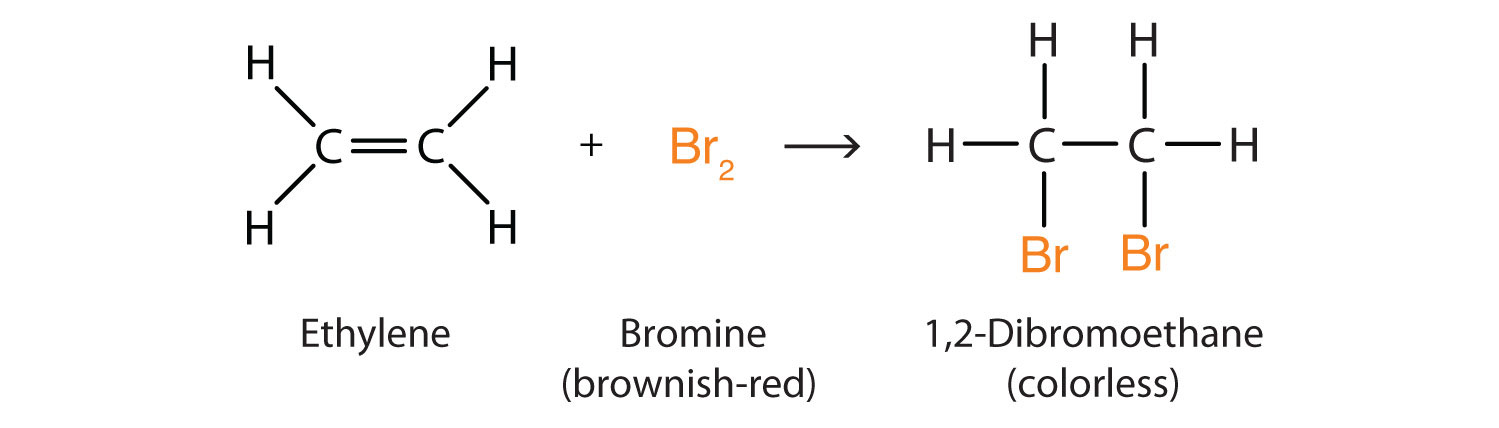
Also, to bond to two bromines, the alkene must make its double bond a single bond, hence the name addition reaction
Sunday, May 29, 2016
1.55 Write ionic half-equations representing the reactions at the electrodes during electrolysis
At positive (anode) electrode, electrons are lost.
eg 2Br- > Br2 + 2e-
At negative (cathode) electrode, electrons are gained.
eg 2H+ + 2e- > H2
*Make sure charges are the same on both sides!!
eg 2Br- > Br2 + 2e-
At negative (cathode) electrode, electrons are gained.
eg 2H+ + 2e- > H2
*Make sure charges are the same on both sides!!
1.54 Describe experiments to investigate electrolysis, using inert electrodes, of aqueous solutions such as sodium chloride, copper(II) sulfate and dilute sulfuric acid and predict the products
- Place inert electrodes in aqueous ionic solution
- At positive electrode (anode), - ion will form an atom (non metal)
- At negative electrode (cathode), + ion will form an atom (metal)
eg
- Sodium chloride: sodium at cathode, chlorine at anode
- Copper(II) sulphate: copper at cathode, oxygen at anode, sulphur stays in solution
- Sulphuric acid: hydrogen at cathode, oxygen at anode, sulphur stays in solution
To help remember:
CINDY IS NOT AN INDECENT POTATO:
Cathode
Is
Negative
Anode
Is
Positive
NAP MAN:
Non-metal
At
Positive
Metal
At
Negative
CCOASS (for copper(II) sulphate)
(Cathy Chopped Apples And Stabbed Sue)
Copper
Cathode
Oxygen
Anode
Sulphur
Solution
HCOASS (for dilute sulphuric acid)
(Henry Cut Onions And Started Sulking)
Hydrogen
Cathode
Oxygen
Anode
Sulphur
Solution
1.53 Describe experiments to investigate electrolysis, using inert electrodes, of molten salts such as lead(II) bromide and predict the products
%20bromide%20image%201.JPG) |
| Figure 1 |
- Set up the apparatus in figure 1
- The lead (metal) will be attracted to the negative cathode where it will gain electrons
- The bromine (non metal) will be attracted to the positive anode where it will lose electrons
- Lead and bromine formed
- Yay
Inert electrodes don't react with other substances - only play a role in electron transfer and you need to be able to draw that apparatus. Good luck, padawan.

1.52 Understand that electrolysis involves the formation of new substances when ionic compounds conduct electricity
Ionic compounds conduct electricity when molten or in solution. During electrolysis, positively charged ions move to one side (cathode, which is the negatively charged electrode) and form metals. The negatively charged ions move to the other side (anode, the positively charged electrode) to form non metals. This is because opposite charges attract. These ions become atoms / new products because they undergo a reaction where either a gain or loss of electrons occurs.
TO REMEMBER:
Cathode
Is
Negative
Anode
Is
Positive
Cindy Is Not An Indecent Potato
TO REMEMBER:
Cathode
Is
Negative
Anode
Is
Positive
Cindy Is Not An Indecent Potato
1.51 Describe experiments to distinguish between electrolytes and non-electrolytes
- Set up a circuit with an LED light, a battery/power pack, wire and a solution
- Create a gap between the two ends of the wire. Place them in the solution.
- Switch the power pack on (if required)
- If LED lights up, a current is flowing through the molten substance / solution. This means it is an electrolyte.
- If it doesn't light up, there's no current, therefore it is not an electrolyte.
Or you could just...

Subscribe to:
Posts (Atom)